
How to Optimize the Image Pipeline and AGC with the FLIR Lepton Thermal Camera Module
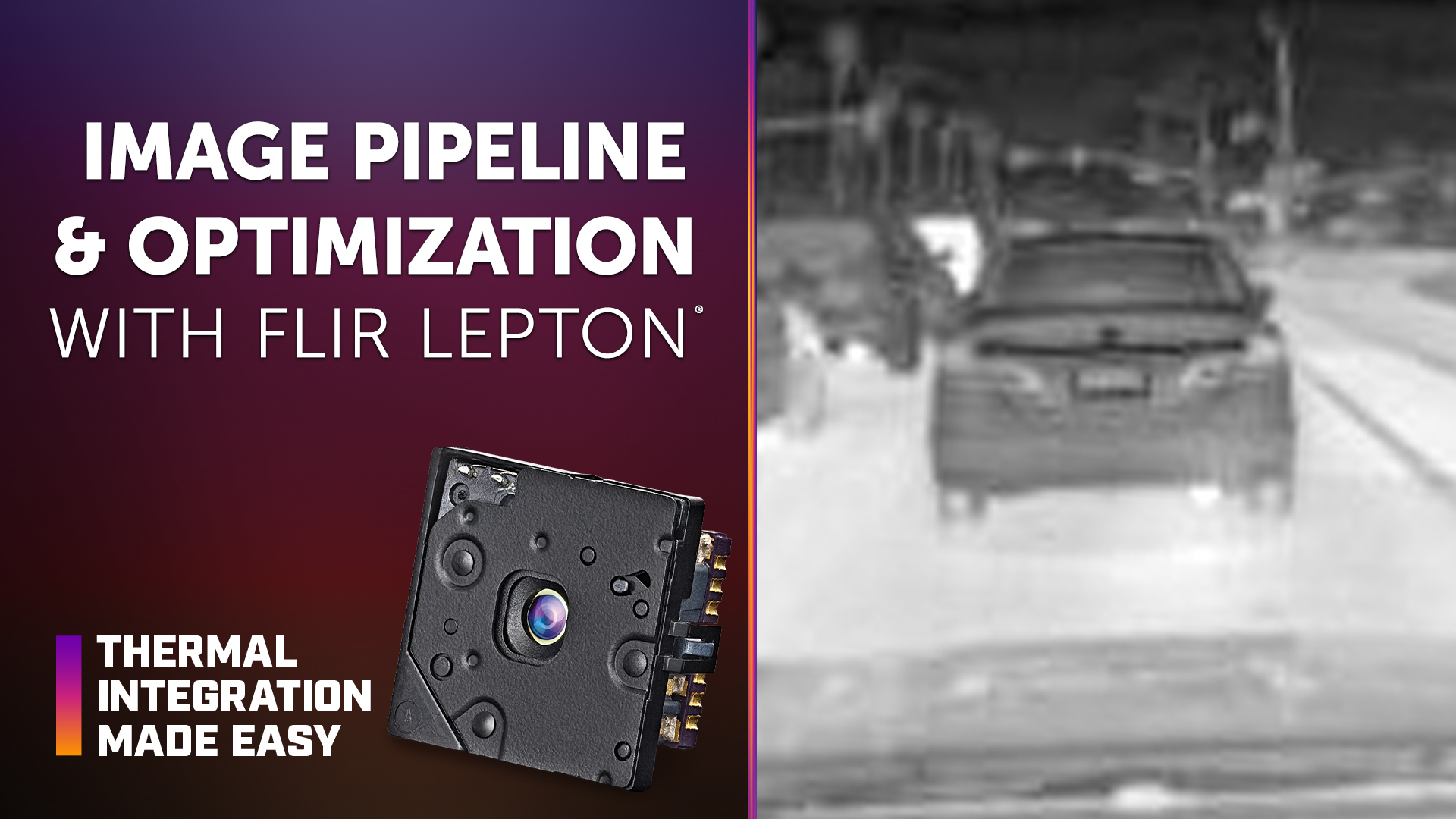
The FLIR Lepton® thermal camera module provides multiple video output formats that allow OEM developers to optimize thermal imagery based on application requirements. Selecting the appropriate output depends largely on whether the system requires radiometric temperature data, high-contrast imagery for display, or both.
In this episode of Thermal Integration Made Easy, engineers and developers learn how the Lepton image pipeline handles radiometric and non-radiometric video, including T-linear and T-stable outputs, 8-bit and 16-bit data, and automatic gain control (AGC). The video also explains how linear AGC and plateau histogram equalization affect thermal image contrast and when AGC processing should be performed on the camera or the integrator's host platform.
Key Takeaways
What video outputs are available from the FLIR Lepton thermal camera module?
Lepton provides multiple video formats from different stages of its image pipeline. The appropriate output depends on whether the application requires radiometric temperature data, high-contrast thermal imagery, or both.
Are FLIR Lepton 2.5 and Lepton 3.5 radiometric?
Yes. According to the video, Lepton 2.5 and Lepton 3.5 support radiometric operation, and radiometry can also be disabled when temperature measurement is not required.
What happens when radiometry is disabled?
When radiometry is disabled, the camera output is not necessarily linearly proportional to scene temperature because the output is affected by the temperature of the camera.
What is T-linear output?
T-linear provides a 16-bit output that is linearly proportional to scene temperature. When temperature measurement is required, the video recommends using T-linear output.
What is T-stable output?
T-stable stabilizes the camera output when radiometry is enabled. Unlike T-linear, additional conversion is required to derive temperature from the T-stable output.
When should the Lepton 8-bit interface be used?
The 8-bit or AGC interface is generally appropriate when radiometric temperature data is not required and the primary objective is displaying high-contrast thermal imagery.
What is post-AGC RGB888 output?
When AGC processing occurs on the camera, Lepton can provide post-AGC RGB888 video. This output is suited for applications that need thermal scene contrast for display but do not require radiometric temperature data.
Can Lepton output radiometric data and post-AGC video simultaneously?
The video states that only one video output is available from the camera. When an application requires both temperature data and high-contrast imagery, AGC processing must therefore be implemented on the integrator's host platform.
What is automatic gain control in thermal imaging?
Automatic gain control converts higher-bit-depth thermal image data into an 8-bit range suitable for display while optimizing the available grayscale range to improve scene contrast.
What is linear AGC?
Linear AGC maps the useful span of higher-bit-depth thermal data into the available 8-bit output space. This removes unused portions of the source range and allows the displayed grayscale range to represent more of the relevant scene data.
What is plateau histogram AGC?
Teledyne FLIR's AGC uses plateau histogram equalization. This technique optimizes image contrast while limiting how strongly certain objects influence the histogram used to map thermal data into the 8-bit output range.
How does plateau histogram equalization improve thermal imagery?
Plateau histogram equalization distributes pixel intensities more effectively across the available output range. According to the video, this can produce a clearer, higher-contrast image than a standard linear AGC transformation.
When is custom AGC processing required?
Custom host-side AGC may be useful when an application requires both radiometric temperature data and optimized high-contrast video, or when additional image processing is required beyond the onboard plateau histogram AGC.
Does every Lepton integration need a custom AGC?
No. If radiometric data is not required, the video states that the RGB output directly from Lepton can provide the necessary high-contrast imagery without requiring development of a custom plateau histogram AGC.
What are the tradeoffs of implementing custom AGC?
Developing and optimizing a custom AGC can require additional development time and host-system processing bandwidth. Teledyne FLIR can provide a basic plateau histogram AGC example, but application-specific optimization remains the responsibility of the integrator.
What platforms can be used to develop with FLIR Lepton?
The video identifies Raspberry Pi for Linux or processor-based implementations and Windows paired with a PureThermal board for development and testing.
How can Lepton video be accessed on Windows?
The video demonstrates the Lepton User App paired with a PureThermal board, which provides a standard universal serial bus (USB) output and streams video using USB Video Class (UVC)
Products & Technology Featured
FLIR Lepton Micro Thermal Camera Module
FLIR Lepton is a compact longwave infrared (LWIR) thermal camera module designed for OEM integration. Developers can access thermal video, camera parameters, telemetry, and command and control functionality when integrating Lepton into processor-based systems and other thermal imaging applications.
Looking for additional technical resources or support?
Visit our Support Center for documentation, software downloads, and troubleshooting guidance.
Engineering Documents
Brochures