Thermopile Arrays vs. the FLIR Lepton Micro Thermal Camera Module: What’s the Difference?


Thermopile Arrays vs. the FLIR Lepton Micro Thermal Camera Module: What’s the Difference?

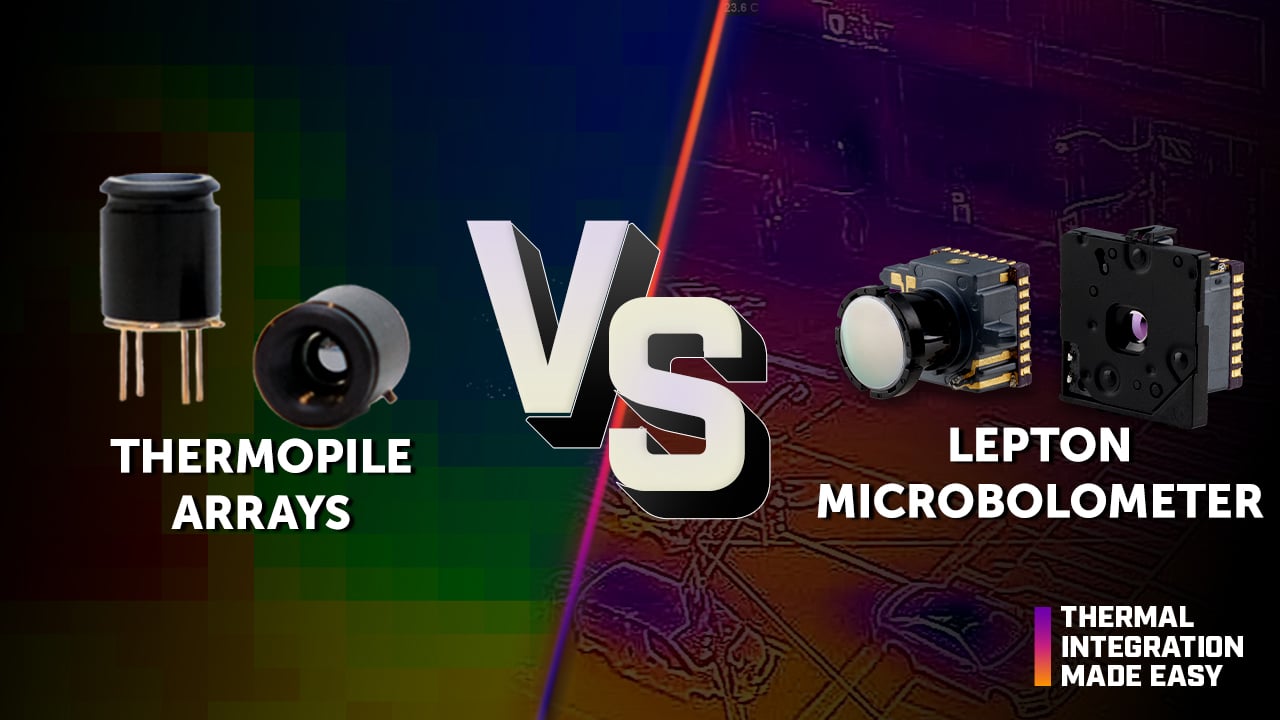
Thermopile arrays and microbolometer-based thermal camera modules can both detect infrared energy, but they provide very different levels of thermal information. Thermopile arrays are well suited for basic detection and temperature-sensing applications, while higher-resolution thermal imagers can provide the detailed thermal data needed for more advanced analysis and intelligent systems.

In this episode of Thermal Integration Made Easy, OEM engineers and developers learn how thermopile arrays compare with the FLIR Lepton® micro thermal camera module. The video explores differences in detector technology, resolution, sensitivity, temperature range, size, weight, cost, and field of view (FOV), as well as applications ranging from occupancy and spot temperature sensing to smart home automation, drones, and fire detection.

Key Takeaways

What is a thermopile array? A thermopile converts thermal gradients into an electrical voltage that can be used for infrared sensing. Thermopile arrays typically offer resolutions ranging from 4 × 4 to 32 × 32 pixels and can support basic applications such as occupancy detection and spot temperature sensing.

How does FLIR Lepton differ from a thermopile array? Lepton uses microbolometer technology that measures changes in pixel resistance caused by incoming infrared energy. With resolutions ranging from 80 × 60 to 160 × 120 pixels in the models discussed in the video, Lepton provides substantially more thermal image detail than lower-resolution thermopile arrays.

What is the difference between a thermal detector and a thermal imager? A detector provides limited information that can be used to identify conditions such as presence or occupancy. A thermal imager provides a visual representation of the thermal scene, allowing a system to distinguish objects, patterns, and temperature differences for more complex analysis.

When is a thermopile array appropriate? Thermopile arrays can be suitable for applications that require basic thermal detection rather than detailed thermal imagery, such as occupancy sensing and spot temperature measurement.

When is a microbolometer thermal camera module a better option? A microbolometer-based thermal imager such as Lepton can support applications that require greater image detail or more complex thermal information, including smart home automation, drones, and fire detection.

How do thermopile arrays and Lepton compare in resolution? Thermopile arrays discussed in the video range from 4 × 4 to 32 × 32 pixels, while Lepton offers resolutions from 80 × 60 to 160 × 120 pixels. The higher pixel count provides more detailed information about objects and temperature patterns within the scene.

What does SWaP mean for thermal imaging systems? Size, weight, and power (SWaP) are important considerations when integrating thermal sensing into compact systems. Lepton is optimized for applications that need higher-resolution thermal imaging in a small, lightweight, low-power design.

How do thermopile arrays and microbolometers compare in cost? Thermopile arrays have historically offered a lower-cost approach to basic thermal sensing. According to the video, improvements in microbolometer manufacturing yield and production have narrowed the price gap, making higher-resolution thermal imaging practical for a broader range of applications.

Why can higher-resolution thermal imaging benefit AI-enabled systems? Higher-resolution thermal imagery provides more information about objects and thermal patterns within a scene than basic detection alone. This additional data can support smarter systems and more advanced artificial intelligence (AI)-driven analysis.

What factors should developers consider when comparing thermopile arrays and microbolometers? The video compares technologies across resolution, sensitivity, temperature range, size, weight, cost, and field of view. The right technology depends on how much thermal information the application needs and the system's overall design requirements.

Products & Technology Featured

FLIR Lepton Thermal Camera Module

FLIR Lepton is a compact longwave infrared (LWIR) thermal camera module designed for integration into embedded electronics and thermal imaging systems. Its small form factor requires careful mechanical design around mounting, thermal management, field of view, protective windows, and shutter operation.

Looking for additional technical resources or support? Visit our Support Center for documentation, software downloads, and troubleshooting guidance.

 
Related Articles