How to Electrically Interface the FLIR Lepton Thermal Camera Module


How to Mechanically Integrate the FLIR Lepton Thermal Camera Module

Successful electrical integration of the FLIR Lepton® thermal camera module requires the correct power supplies, clock signals, communication interfaces, and synchronization. Understanding these electrical requirements can help developers maintain reliable camera operation and consistent thermal video while avoiding common integration issues such as dropped frames.

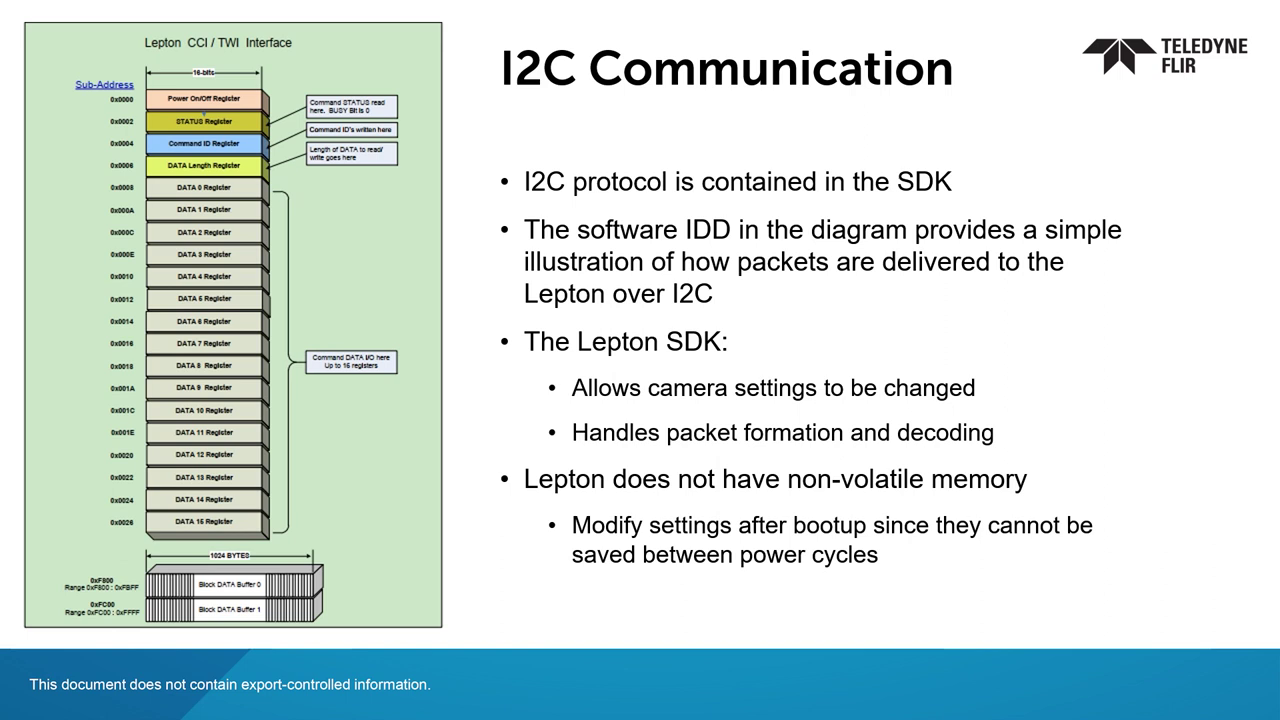
In this episode of Thermal Integration Made Easy, OEM engineers and developers learn about Lepton's power requirements, Master Clock, serial peripheral interface (SPI), inter-integrated circuit (I2C) communication, vertical synchronization (VSYNC), and general-purpose input/output (GPIO) connections. The video also covers electrical design considerations for power consumption, clock selection, dedicated communication buses, and processor performance.

Key Takeaways

What electrical interfaces does FLIR Lepton require? Lepton connects through a Molex socket and uses multiple electrical interfaces, including SPI, GPIO connections, three separate power supplies, a mandatory Master Clock, and active-low power-down and reset pins used for power cycling.

What are the power requirements for FLIR Lepton? Three separate power supplies support different sections of the camera module. Power consumption is relatively low but can peak during a flat-field correction (FFC) event when the mechanical shutter activates. Current draw can also increase as the camera approaches its maximum operating temperature of 65°C.

Why is VSYNC recommended when integrating Lepton? VSYNC helps synchronize SPI interactions between Lepton and the host system. Using VSYNC can help maintain steady thermal video and reduce dropped frames.

What is the Master Clock used for? The Master Clock operates the Lepton ASIC at 25 MHz. A consistent clock signal and appropriately selected oscillator are important for reliable operation of the camera electronics.

Does FLIR Lepton require a dedicated SPI bus? Yes. Lepton requires a dedicated SPI bus that is not shared with other devices. The video also recommends providing Lepton with its own I2C bus.
What clocks interface with FLIR Lepton? Three clocks are used with Lepton: the Master Clock operates the ASIC, the SPI clock supports thermal video, and the I2C clock supports camera communication.

How can developers reduce dropped frames when streaming Lepton video? The video recommends using VSYNC for reliable synchronization. When a host processor has difficulty keeping up with the thermal video stream, a microcontroller unit (MCU) can also be used to assist with frame grabs.

Why is oscillator selection important for Lepton? The oscillator must provide an adequate and consistent signal to the onboard ASIC. Selecting an oscillator that meets Lepton's requirements helps support reliable camera operation.

What electrical design resources are available for Lepton integration? The Lepton engineering datasheet provides additional electrical specifications, while schematics, board (BRD), and design (DSN) files are available upon request. Development board schematics can also provide reference information for electrical integration.

How to Electrically Integrate FLIR Lepton

  1. Connect Lepton using the required Molex socket. The module should be correctly oriented according to the specified socket pinout.
  2. Provide the required power supplies. Three separate power supplies are used to power different sections of the camera module.
  3. Provide a stable Master Clock. The Master Clock should provide a consistent 25 MHz signal to operate the onboard ASIC.
  4. Use a dedicated SPI bus. Lepton's SPI bus should not be shared with other devices, and a dedicated I2C bus is also recommended.
  5. Use VSYNC for synchronization. VSYNC can synchronize SPI interactions between Lepton and the host system and help reduce dropped video frames.
  6. Confirm adequate host processing. If the processor cannot reliably keep up with the Lepton video stream, a microcontroller unit can assist with frame grabs.
  7. Verify power and thermal requirements. The system should account for increased power draw during FFC events and at higher camera operating temperatures.

Products & Technology Featured

FLIR Lepton Thermal Camera Module

FLIR Lepton is a compact longwave infrared (LWIR) thermal camera module designed for integration into embedded electronics and thermal imaging systems. Its small form factor requires careful mechanical design around mounting, thermal management, field of view, protective windows, and shutter operation.

Looking for additional technical resources or support? Visit our Support Center for documentation, software downloads, and troubleshooting guidance.

Download PDF Version

Related Articles